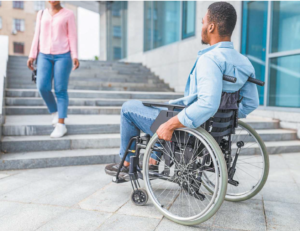
The International Day of Persons with Disability put a spotlight on disability rights

By Jameela Jaddoo
For the International Day of Persons with Disabilities, marked on 3rd December, News on Sunday spoke to key stakeholders and a student with a disability, who shed light on the daily realities, barriers and hopes of persons with disabilities in Mauritius.
The Implementation Gap
As the world marked the International Day of Persons with Disabilities 2025 under the theme “Fostering disability-inclusive societies for advancing social progress”, Mauritian activist Ali Jookhun OSK warns that the island still risks leaving thousands behind if it does not move from declarations to concrete action.
From his vantage point as Chairperson of the African Down Syndrome Network (ADSN), he sees the same patterns repeating themselves: legal progress on paper, but daily life that remains difficult, often exhausting, for persons with disabilities and their families.

For Ali Jookhun, the urgent challenges are clear. He points first to the basics that still fail many citizens: access to schools, work, and community life. As he explains, “the most urgent issues include limited access to quality education, employment and barriers, insufficient community-based support, and continued reliance on a medical model for disability benefits.” The result is a cycle that goes far beyond individual hardship. “Many persons with disabilities face exclusion due to inaccessible infrastructure, lack of reasonable accommodation, and negative attitudes rooted in charity models rather than rights. Disability and poverty often reinforce each other, especially for families providing lifelong care with minimal assistance,” he utters.
Yet Mauritius is not starting from scratch. In recent years, the country has taken some important steps to align itself with the United Nations Convention on the Rights of Persons with Disabilities (UNCRPD). Ali Jookhun highlights the Protection and Promotion of the Rights of Persons with Disabilities Act (2024), which, though not yet promulgated and imperfect, is a crucial step towards UNCRPD compliance.”
“True progress, owners of the legislation state, recognising the age-15 barrier for disability pensions and slowly opening up mainstream education are ‘positive steps’, alongside employment incentives that already exist but need they properly monitored. “True progress, owners of businesses, hiring and patterns,” he declares.
That “implementation gap” runs through almost every aspect of disability policy, he says. Rights can look impressive in legislation, yet remain invisible in daily life. “The main challenge is implementation. Rights on paper often do not translate into reality.” According to him, enforcement mechanisms suffer from unclear institutional responsibilities and a persistent reliance on the medical model to determine access to pensions. Accessibility in transport, schools, buildings and workplaces is still inconsistent, often depending more on goodwill than on binding standards. “Without systematic follow-through, inclusion remains aspirational,” he asserts.
This is precisely why he believes the 2025 theme matters so much in the Mauritian context. For Ali Jookhun, “fostering disability-inclusive societies” is not about charity or pity—it is about how a country defines progress itself. “The thing is: ‘Fostering disability-inclusive societies for advancing social progress’ calls for a shift from charity to a rights- and development-based approach. Inclusion should not be symbolically referenced but embedded in national progress. A nation cannot claim to be advancing if a whole segment of its population remains excluded from school, work, healthcare, political life or even disaster preparedness.”
Ahnas Hyderali – A Student’s Daily Battle With Accessibility
For many in Mauritius, getting to school, catching a bus or climbing a flight of stairs is routine. Yet for Careem Mohammad Ahnas Hyderali, a young student who is paralysed in the lower body, each of those moments can become a test of infrastructure, attitude and resilience.
He introduces himself without drama, just facts: “I am paralysed in the lower body. I have been a student of the Royal College of Port Louis, ranked 9th in Mauritius on the economics side at the HSC exams. Now I am pursuing my tertiary education (ACCA).”

Behind that achievement is a long list of obstacles overcome in transport. “Accessibility” for him is not a slogan; it’s the difference between getting to class or staying home. Even his former school, the Royal College of Port-Louis (RCPL), was not initially designed to welcome a wheelchair user. “Likewise, the secondary school which I attended (RCPL) was not accessible, but thanks to the then government and associations such as CISE Mauritius and CHH in Cassis, we were revamped to accommodate me.”
Beyond infrastructure, he credits people — not policies — with making his education possible. “I am also indebted to various key persons that I have come across, from my teachers to my classmates and friends, to the Gr8-Teaching staff at RCPL, who have motivated me strongly, made me feel included in all aspects and events and granted me their invaluable support all along my academic journey. I owe my success to them,” he states.
His support network extends to spiritual mentors, too. “I am grateful to my spiritual teachers (Ustaad) and the friends I have made in my Islamic education journey; they have been and are the backbone to what I stand today. Overall, I have had a very positive attitude from people in my surroundings, and I have had the support of many around me.”
Because of this strong circle, Ahnas says he rarely feels socially excluded. “Personally, I feel that too much is really implemented in the way that persons with disabilities are facilitated appropriately. Nevertheless, there is still room for more improvement to be made, especially in the public landscape,” he utters.
On public perception, he is clear-eyed. Sometimes, he notes, the pity is that people pity persons with disabilities. The government has passed on some laws in the disability bill so that people with disabilities get some rights and feel equal opportunities are being given to them to pave their steps and contribute to Mauritius’ economy.”
His recommendations are concrete: “Government should back their words and back that up with real opportunities. “Public buses should be accessible to wheelchairs. Older buildings, especially public offices, should be equipped with ramps and lifts. The government needs to encourage the recruitment of persons with disabilities firstly in its own public sector, and then the private sector, and see to it that arrangements are being made to provide the necessary facilities.”
The shift he wants to see—in mindset — from pity to respect. “Policymakers should bring forward new innovative measures and models to facilitate people with disabilities and the general public to learn to view people with disabilities in an equal regard, not as a burden nor out of pity, but as someone possessing an innate different skill and mindset to bring another level of contribution to society.”
NO RELIABLE DATA
Reliable data is another missing pillar. If the country does not know how many persons with disabilities there are, what types of disabilities they live with, and how they are distributed geographically, it cannot plan or budget effectively. “Data is insufficient. Household census figures do not accurately reflect disability types, service access, or poverty levels. A home census alone is unreliable,” he argues. For Ali Jookhun, the data is far from clear: “A dedicated, regularly updated disability survey by the parent ministry is essential. A national database developed with Disabled Persons’ Organisations (DPOs) is critical for effective budgeting and service delivery.”
Money, too, needs to be better targeted. While schemes exist, he believes they do not yet match the reality of people with high support needs. “Budgets are often inadequate and poorly targeted. Persons with high support needs remain underserved. Funding should focus on personal assistance, assistive technology, accessible transport, and independent living support that enables long-term inequality and fosters independence.”
Another recurring issue is participation. Persons with disabilities are often invited to consultations, but their input does not always shape the final decisions. “Participation is often symbolic. Consultations rarely influence decisions,” he states. A recent example, he notes, is a ministerial declaration that emphasized high-level engagement while neglecting the crucial technical spaces where experts, DPOs and other stakeholders submit evidence-based proposals. “Persons with disabilities must occupy real leadership roles in technical committees, policy councils, and monitoring bodies,” he avers.
THE WAY FORWARD
Despite these challenges, Ali Jookhun has seen how powerful change can be when self-advocates are at the centre. He recalls the last International Day of Persons with Disabilities, when mainstream students worked with U-Link and the Down Syndrome Association, Mauritius. The interactions transformed attitudes, challenged misconceptions, and fostered equality-based dialogue. Beyond one-off events, he says, self-advocates have led awareness campaigns and built peer networks. “When people with disabilities share their experience, inclusion becomes practical, measurable, and sustainable,” he affirms.
Looking ahead to the next three to five years, his roadmap is concrete. He calls on authorities to “Promulgate and enforce the 2024 Act with monitoring mechanisms”, “Create a national disability mainstreaming unit with collaboration”, “Ensure reasonable accommodation in schools, workplaces, and public services”, “Invest in independent living: personal assistance, assistive technology and accessible transport”, and “Implement the 3% employment quota co-designed with NGOs and DPOs.” The employment front also has a role: “To present rights-based representation led by disabled voices.”
For Ali Jookhun, excuses about economic pressure are no longer acceptable. “Without proper investment, meaningful policies and budgets remain rhetoric. Inclusive persons with disabilities, inclusion remains an empty slogan—sweet in speeches but ineffective in reality. Economic difficulties can no longer justify inaction. True inclusion requires deliberate planning, funding, and sustained political will.”
His final message is both a warning and an invitation: “Inclusion is not charity—it is a responsibility that defines our justice, equality, and national progress.”
APDH WARNS INCLUSION STILL OUT OF REACH FOR MANY MAURITIANS WITH DISABILITIES
Although the 2025 theme for the International Day of Persons with Disabilities – “Fostering disability-inclusive societies for advancing social progress” – carries a hopeful message, the reality on the ground tells a different story. For Ashvin Gudday, Vice President of the Association pour la Protection des Droits des Handicapés (APDH), daily life for many persons with disabilities still falls far short of that vision.

For him, the core problems have not changed enough. “The biggest obstacles remain inclusion, accessibility at all levels, and equal opportunities for persons with disabilities,” he states.
Behind that broad diagnosis lie very concrete failures. Some, he points out, are still struggling to have their rights recognised in practice. “Persons with disabilities still struggle to obtain justice and are often victims of discrimination on multiple fronts.”
Basic infrastructures that most citizens take for granted remain out of reach. On top of physical barriers, he warns that prejudice and online violence add an invisible layer of harm. “We must not forget that stigma and people’s attitudes can also cause harm. Especially today, with virtual spaces and cyberbullying, the risk of hurtful comments online can deeply affect individuals,” he says.
PROGRESS IN INCLUSION
Yet Ashvin Gudday is careful to acknowledge the progress made. Social protection and support schemes have evolved over time. “But if I have to be objective, I would say that today we have still made progress in terms of social protection, allowances, and financial support. There are more possibilities in terms of access to Special Education Needs, though not fully adequate yet.”
On the legal side, the sector has been waiting for one key piece of legislation to finally take effect. “Regarding legislation, we are awaiting the proclamation of the Protection and Promotion of the Rights of Persons with Disabilities Act, a law passed last year to strengthen the rights of persons with disabilities. The Equal Opportunities Act, and of course, the Constitution of the country, also encompass the rights of Mauritian citizens,” he explains.
But legal texts alone are not enough. Mauritius, he says, must match them with action. Beyond legislation, he genuinely wants to empower persons with disabilities. “It is essential that we align our national policies with the articles of the United Nations Convention to ensure their full empowerment.”
On accessibility, the picture is clearly failing. Ashvin Gudday does not mince his words. Education is a first, glaring example. “We are failing in several areas. In the Education sector, for example, many of our educational institutions are not adapted to the needs of children with disabilities,” he avers. From inaccessible buildings to attitudinal barriers, the gaps are wide. “Many children seeking support are still waiting, as there is a serious lack of personnel, support teachers, and carers,” he adds.
The employment front is no better. A quota has existed on paper for nearly three decades, but Ashvin insists it has never really been enforced. “The 3% recruitment quota for companies with at least 35 employees, as required under the Training & Employment of Disabled Persons Act of 1996, has never truly been enforced,” he affirms. He also underlines that transport and public space remain daily struggles.
A NEED TO REFORM THE SYSTEM
For APDH, that entire policy framework now needs a serious rethink. “All these policies must be reviewed. Social benefits and disability pension systems still rely on a medical-model approach must be reoriented toward a human- and rights-based approach. A reform of the system and a review of the functioning of the Medical Board are urgently needed,” he warns.
Against that sobering backdrop, the 2025 theme feels both hopeful and fragile. “This year’s theme is strong and meaningful, but political will is essential to make it a reality. Otherwise, it remains just a slogan if actions do not follow,” utters Ashvin Gudday.
The advocacy community will continue to push, but the responsibility, he says, is shared. “As activists, we will remain vigilant and continue to advocate for the rights of PWDs. Each government shall make efforts required, and even when well sensitised, can play a key role.”
Part of the problem, Ashvin Gudday believes, is a deeper pattern: policies that look good in speeches but stall in implementation. He argues for both stronger financial commitment and a genuinely holistic approach.
Data is another weak point. According to him, numbers and statistics are not being used in a strategic, prevention-oriented way. “According ot the census, we have around 86,000 PWDS & 1 billion in the world. It would be interesting to have a breakdown of each disability and try to analyse the causative factor behind.”
With diverse disabilities and causes—from birth to accidents or disease—and with an ageing society, we need to prepare seriously. “We have many types of disabilities, physical, mental, and sensorial. Some disabilities are invisible, and we need a specialised approach for each type of disability Mauritius, being an ageing population, is at risk from age-related disabilities; we shall establish a scientific methodology to sensitise the population at each level. Prevention is better than cure.”
Inside APDH, the focus is on building leadership and confidence among members. “At our association, we support and empower members to live their dream to dare raise their voice and aspire for a better future.”
He believes the government should mirror this spirit by opening up democratic participation. “The Government should create platforms for dialogue with and trust all stakeholders, together with democratic participation of PWDS, will be the right way in doing so. APDH has long proposed that through an electoral reform, we can introduce a “dose de proportionnelle” to enable PWDS to be represented in the parliament.”
On a moral level, Gudday lays out an agenda for the state and for the media. “The government shall consolidate the rights of PWDS through proper legislation, for example, by reinforcing Section 16 of the Constitution to ensure protection against discrimination. The State should also promulgate the Protection & Promotion of the right of PWDS Act soon after amending where required. The Government should do good listening and organise regular consultations. There should also be better promotion of sign language & communication at every event. The Government should organise regular sensitisation programmes to raise awareness and report where there has been any kind of injustice against a PWDS.”
His final reminder is a sober one: disability can concern anyone, at any time.
“We should make inclusion of this world a better place through proper inclusion & equal opportunities for PWDS as “personne n’est à l’abri d’une catastrophe” that can lead to a disability.”