Siphamandla Maduna

Siphamandla Maduna had cerebral palsy. Cerebral palsy never had him.
There’s a scene Siphamandla Maduna has carried with him for most of his life. A boy from Ixopo, a quiet village in KwaZulu-Natal, was watching from the sidelines as older boys took over the playing field during school holidays. He wanted to be out there. He always did. But having cerebral palsy meant that some doors — or at least some playing fields — did not always open for him.
“That used to hurt me,” he says plainly, without drama, “because I always loved being active, but my condition meant there were moments where I was left out.”
That kind of honesty tells you a lot about who Siphamandla is. He does not dress things up or ask for sympathy. He just tells you what it was, and what he did with it.
Maduna grew up raised by a single mother in a humble Ixopo home. She grounded him in values he still carries today — about perseverance, about showing up, about not letting the world define what you are capable of. When he was sent to a special needs boarding school, he did not fully understand it at first. What he did understand was that he loved sport, and no diagnosis was going to take that from him.
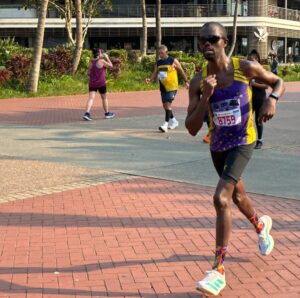
Running found Maduna. Or perhaps more accurately, he found running and did not look back. Among all the sports he loved watching and following, the road became his arena — the one place where a diagnosis does not set the terms, where the only real conversation is between your body, your mind, and the kilometres stretching out ahead of you.
Then came the dream that had always sat quietly at the back of his mind: the Comrades Marathon. South Africa’s Ultimate Human Race. Eighty-nine kilometres of hills, heat, heart and history.

Maduna’s original plan was modest by Comrades standards — run 70km, stop, and walk away satisfied that he had done it once in his life. But the race, as Comrades so often does, had its own ideas. Standing at the start line, somewhere between nervousness and resolve, Siphamandla crossed into something that changed him. The finish line did not just represent a distance covered — it represented every playing field he had been kept off, every moment he had been told, directly or indirectly, that his body set the ceiling on his dreams.
“Sometimes it still feels like a dream that I did it,” he says. What made the experience even more meaningful was the community that ran alongside him — his club, Hollywood Athletics Club, who showed up and held space for him in ways that genuinely mattered. It was not just about the training plans or the early morning runs. It was about belonging somewhere that believed in him.
Siphamandla Maduna is an athlete with Hollywood Athletics Club, and the relationship between him and the club is a testament to what sport can be when it is done right. Hollywood Athletics Club has created an environment where athletes are not simply tolerated but celebrated — where a man with cerebral palsy from a small KZN village can stand on the same start line as everyone else and be fully, completely part of the story.
He is not done. Not even close. This year his focus is on earning a back-to-back Comrades medal, with a specific goal of achieving a Bill Rowan on the Up Run — targeting a finish time between 8:22 and 8:55. That is not a man running for survival. That is a man running with ambition, discipline and a carefully considered plan.
Off the road, Siphamandla carries his purpose into digital spaces, using social media to educate and inspire others about running — sharing lessons he has learned the hard way, keeping followers motivated and consistently reminding people that this sport has room for everyone. There is something generous about that. He could keep his hard-won knowledge to himself, but instead he turns it outward, making himself a resource for others who are still figuring out whether they belong in the running community.

Ask Maduna why he pushes his body like this, and he does not hesitate. “The purpose is bigger than the distance.” His motto — Inspiration of the Nation — is not a tagline. It is a mission statement rooted in something deeply personal. He wants to show people, especially persons with disability, that they can achieve anything they set their minds to. Not in a vague, motivational-poster kind of way. In a put-your-running-shoes-on-and-prove-it kind of way.
Maduna’s mother and sister have always been his biggest supporters — standing beside him even when they did not fully understand his decisions. That unconditional backing, layered with the environment Hollywood Athletics Club has built around him, has given him something rare in sport and in life: a safe space to be both vulnerable and extraordinary at the same time. A place where his ambitions are not seen as unrealistic but as goals worth chasing together.
Siphamandla Maduna is not running away from cerebral palsy. He is running with it — through finish lines, across highways, past every boundary the world once tried to draw around him. And he is doing it on his own terms, at his own pace, with a club behind him and a nation watching.
The road ahead is long. He would not have it any other way.