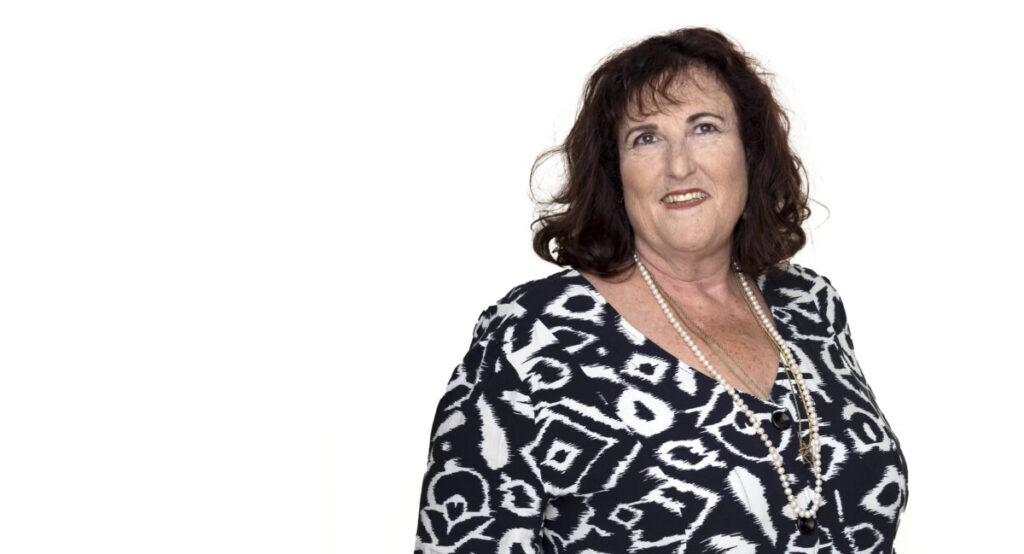
Susan Abro


Durban attorney, Susan Abro, who served as an Acting High Court Judge before returning full-time to private practice because she missed working directly with people. A conversation about longevity, sight, wine, and the quiet business of leaving strangers stronger than she found them.
By Simon Manda
I first met Susan Abro around 2012, introduced by a mutual friend as we sat on Florida Road at the old Spiga d’Oro — Faye Freedman, who built the award-winning Eagle Taxis into a Durban institution, made the connection. Faye spoke of Susan the way people speak of a landmark: something solid you orient yourself by. Then, in the way of good intentions, more than a decade slipped past before we properly sat down again.
Last year I corrected that, inviting Susan Abro to our TRIBUTES Awards Excellence Mayor’s Breakfast at the Coastlands Hotel in Musgrave. Susan came. And when we later dreamed up a twenty-day journey across South Africa, she was among the very first to back it. Some debts you settle by naming them out loud: thank you, Susan. So, when the chance came to sit with her in her Morningside offices — proper, unhurried, face-to-face — it was, as she might put it, a no-brainer.

The farm girl who never left her manners behind
Susan Abro grew up on a farm outside Melmoth, and if you want to understand everything that came after, start there. “You learn to respect everyone,” she says, “values that have stayed with me my whole life.”
She came out of university, in her own telling, knowing nothing — then did her articles and briefly believed she knew everything. “The older you get,” she says, laughing at her younger self, “the more you understand how little you know.” She trained in an all-male firm, made partner in her first year at Woodhead, Bigby and Irving, and then did the thing that defines her: she left the corporate ladder because she is, by her own admission, too independent to fit inside anyone else’s box.
In June 1995 she opened Susan Abro Attorney. Thirty-one years on — and thirty-six years into a legal career spanning more than 3,000 matters, each one somebody’s private catastrophe — she is still there, still at the table.
“Every woman I’ve acted for leaves me much stronger than when she came to me. That, to me, is the best reward.”
What thirty-six years actually buys you
It is tempting to reduce a career like this to a trophy shelf, and Susan Abro’s is heavy: acting Judge of the High Court in Durban; first woman Vice-President of the KwaZulu-Natal Law Society; Co-Chairperson of the Law Society of South Africa; two decades chairing its Family Law Committee, where she helped introduce the concept of arbitration into South African family law. Add the international rooms — Fellow of the International Academy of Family Lawyers, roles in the International Bar Association — and a farm girl from Melmoth has, quietly, helped shape the legal landscape of a country.
But push her on the titles and she waves them off — not out of false modesty, but because she has her priorities in a very particular order. “I’m very grateful to be recognised,” she says. “But it’s about what you put into your community. You don’t do it for the thank-yous. You do it because you’re committed to the cause.”
The recognition has come anyway, and steadily. Her firm was named South African Boutique Family Law Firm of the Year (2017) by the Corporate Global International Awards. The Businesswomen’s Association of South Africa honoured her as Professional Businesswoman of the Year in 2003 — a nod from her own women, given added weight by her having chaired the association’s Durban chapter.
Lawyer Monthly named her Family Lawyer of the Year in both 2016 and 2017. In 2024 she was a finalist in the ABSA Jewish Achiever Awards, one of 25 top KZN women in Business in 2025, and named among the list of KZN top Business Leaders in 2026. These accolades reflect not a single achievement, but a lifetime of dedication to her profession. Susan Abro alma mater, St Anne’s, has also proudly recognised the farm girl from Melmoth as one of its own. She is deeply grateful for each honour, yet quietly unbothered by them all.
Susan Abro sat as an acting judge in 2005 and found it illuminating — “it gives you the view from the other side of the bench” — and then chose not to pursue it. The reason is the whole story in miniature: she missed people. Most of us spend a career climbing toward the bench. Susan reached it, looked around, and came back down to be closer to the humans.
The women who keep the wheels turning
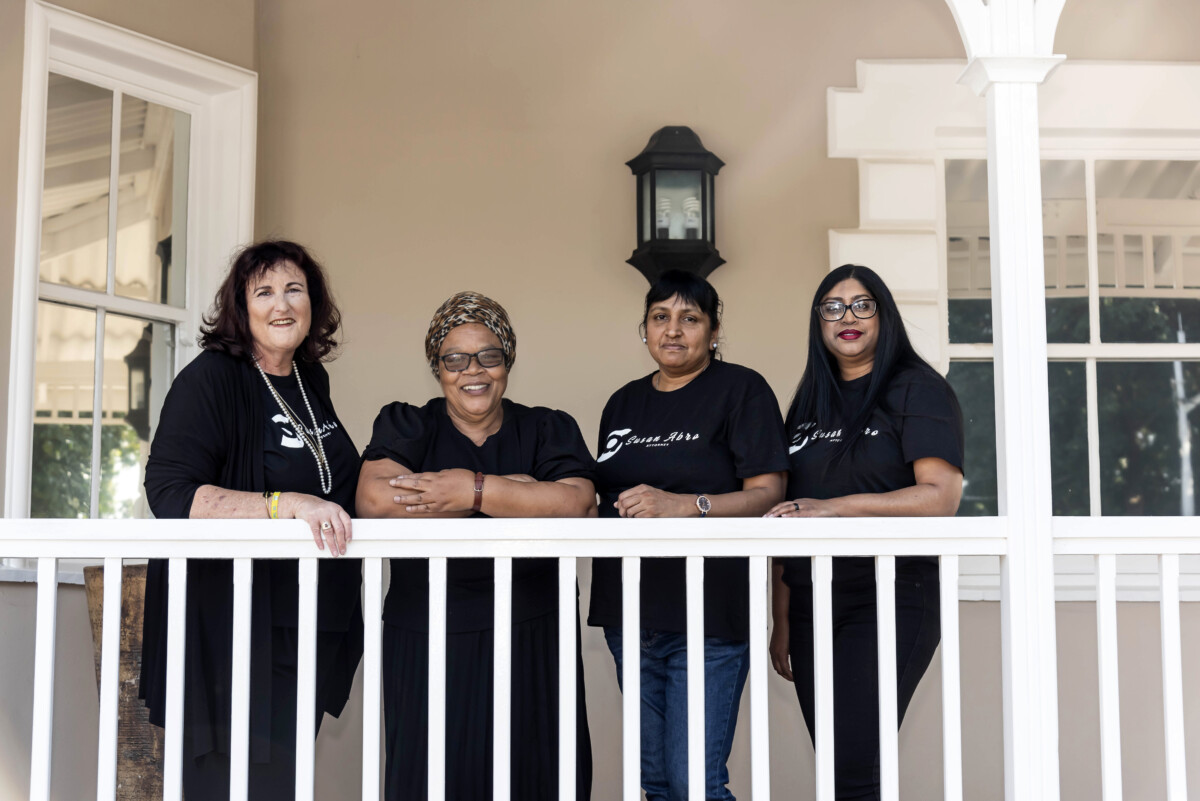
Ask Susan Abro how a boutique practice survives thirty-six years and she does not point at herself. She points at the women around her. Since she stopped driving, her staff have become, in the most literal sense, part of how she moves through the world — and, in a truer sense, the reason the firm holds. “Thank goodness for Uber and my wonderful staff,” she says, and there is nothing throwaway in it.
Susan Abro exercises with them — a personal trainer comes to the office and the team trains together. The practice reads less like a hierarchy with a famous name on the door than a small, loyal ecosystem: her office staff keeping the wheels turning while the principal does what only she can do. It is a way of working she came by honestly.
The women who shaped her — her mother, Charlotte, and her old friend Mathabo Kunene, both still going strong at 86 — modelled exactly this: strength that does not need to shout, and a refusal to be taken advantage of. “Mathabo will not be taken advantage of,” Susan says with obvious affection. “She stands up, and she fights until she wins.” It is the standard she keeps for the women around her, and the one she now sets for the next lot coming through.
Sight as an instrument, not a tragedy
In 2009 Susan was diagnosed with retinitis pigmentosa, a progressive, untreatable condition that had already taken her brother’s sight. “It wasn’t entirely a surprise,” she says — and then, honestly, “of course it was a shock.” She has no central vision now; she stopped driving in 2016.
What is striking is where she refuses to let the story go. “It doesn’t affect your brain,” she says defiantly. “I’m still as good a lawyer as I ever was. And when clients come to me, it’s not an issue for them.” She counts herself lucky to run her own firm: “In a big corporate, you might not find the same understanding.” There is grace in how she speaks of it now — but she is candid that the private version, in the beginning, was harder than the brave one she offers today.
“Losing your vision is difficult. But it’s something you can overcome. You make allowances, and you carry on with life.”
The inheritance: women who worked until their late 80’s
Susan Abro lives with her mother, Charlotte, who retired at the end of last year at the age of 86 — “she’s where my values come from” — and she speaks of the arrangement with open gratitude: “we take care of each other.” Her grandmother worked to 86 and then phoned Susan to ask whether anything could be done about being made to retire.
Then there is Mathabo Kunene — widow of Mazisi Kunene, South Africa’s first Poet Laureate — whom Susan met as a young lawyer and has walked beside for over thirty years, serving as a founding trustee of the foundation that guards his legacy. “Those are the kind of women you want to inspire you,”
Susan Abro says, “because they’re still going, and they have incredible values.” Her own line on longevity is delivered with a grin: “My mother and grandmother both worked until they were 86. I can tell you right now — I am not working till I’m 86.”
On the law of the moment: due process, not vigilantism
For all her warmth, Susan Abro is at her sharpest on the rule of law — and she has been outspoken about the tensions around undocumented immigration in KwaZulu-Natal. Her position is precise. Every sovereign country has immigration laws, she says, and South Africa is no different; the difficulty is who gets to enforce them.
“If a person is in South Africa unlawfully, our immigration laws provide for the appropriate legal processes,” she says. “However, the responsibility for enforcing those laws rests with the relevant authorities — not private citizens. When individuals or organisations begin carrying out their own immigration enforcement, we move away from the rule of law and towards vigilantism. That is a dangerous path for any constitutional democracy.”
Susan Abro is blunt about landlords issuing arbitrary deadlines and businesses shuttered by intimidation: eviction, she notes, follows specific legal procedures that apply regardless of nationality. And she frames the danger in terms anyone can feel: “Today it may be foreign nationals. Tomorrow it could be another vulnerable group. Once society accepts that private individuals can decide who has rights and who does not, the protections of our Constitution begin to erode.”
It is the same instinct that runs through her whole career — protect the person in front of you, and insist the system does its job properly — pointed at a national anxiety.
The table, the wine, and the good life
For a woman who deals in other people’s worst days, Susan Abro is emphatic about the enjoyment of hers. She is a member of the Chaîne des Rôtisseurs — “an international organisation for the enjoyment of the table” — and has been collecting wine since she was, in her words, a baby attorney. When she moved into the Churchill Road premises, she built a wine cellar in the library. “There’s so much,” she admits, “I’m never going to drink it all.”
Friends, she insists, are the family you choose — “your tribe” — and in a job that quietly takes its toll, “you put yourself at the end of the queue, not the beginning.” Which is precisely why the good meals and the tribe are non-negotiable.
The lesson she’d leave on the table
Susan Abro advice to the young is unfussy and hard-won: “If your passion is law, find your passion within law. Don’t be put in a box. Find mentors and ask for help — you’d be surprised how many people are happy to give it. And never burn your bridges.” To women in particular she says: find your organisations, because women network differently — “with empathy and a desire to help each other.”
Thirty-six years in, the dream has shrunk in the best possible way. Not partnership, not the bench, not another award. “My reality is to help people,” she says. “That’s what I’m about.” She wants to travel more, do more NGO work, and spend time giving back.
Not the judge. Not the businesswoman of the year. Just the one who leaves people stronger than she found them. On the evidence of an afternoon in Morningside, she has a while yet — and I, for one, will hold her in the highest regard, professionally and personally.